Part 01Foundation of the technology

From a complex sample to a viable microorganism pellet.

Illustration of a positive blood culture containing microorganisms, human cells, proteins, debris and other sample components

QUICKprep is a manual sample-preparation kit designed to separate bacteria and yeasts from human cells, proteins, debris and other sample components.

Using QUICKprep, the technician recovers a microorganism pellet that can be resuspended and adjusted to the concentration required for the intended downstream method.

Recovery of viable, culturable microorganisms is demonstrated by growth after subculture.

Why sample preparation matters

FASTINOV research in rapid flow-cytometry antimicrobial susceptibility testing demonstrated the importance of preparing a microorganism suspension with sufficient density and reduced interference from the original sample matrix. This requirement contributed to the development of QUICKprep.

01

Treat the original sample

The technician adds the QUICKprep reagents according to the Instructions for Use.

02

Separate sample components

The prescribed reagent treatments and processing steps help separate microorganisms from human cells, proteins, cellular debris and other components of the original sample.

03

Recover the microorganism pellet

After processing, the technician recovers a pellet containing bacteria or yeasts for resuspension.

04

Prepare the required suspension

The recovered microorganisms can be resuspended and adjusted to a standardized 0.5 McFarland suspension, according to the requirements of the intended downstream method.

Procedure summary only. Refer to the current QUICKprep Instructions for Use for complete specimen requirements, volumes, prescribed processing conditions, warnings and operating instructions.

FASTINOV research and proprietary technology

QUICKprep grew out of leading flow-cytometry AST research.

FASTINOV developed rapid flow-cytometry methods for antimicrobial susceptibility testing. Those methods require a clear, consistent inoculum so that microorganism responses can be measured quickly and reliably.

QUICKprep was developed to address that upstream preparation challenge: help separate microorganisms from the sample matrix, support recovery of viable, culturable bacteria and yeasts, and provide a defined starting material for the intended downstream method.

Patents and proprietary researchThe technology underlying QUICKprep is supported by FASTINOV's proprietary research and international patent portfolio.

Part 02Evidence and validation

How the technology performs, and what the published data show.

Primary product performance

Defining preparation success

The primary endpoint evaluates the preparation obtained by a technician using QUICKprep - not the result of a downstream identification or antimicrobial susceptibility test.

100%preparation success

84/84 evaluated preparations met both predefined success criteria.

McFarland >0.5>20 colonies after subculture
01

Sufficient suspension density

Requirement: McFarland >0.5

Sufficient microbial material to prepare a standardized 0.5 McFarland suspension.

McFarland measures suspension turbidity and does not, by itself, demonstrate microorganism viability.
AND
02

Confirmed culturability

Requirement: >20 colonies after subculture

Confirms recovery of viable, culturable microorganisms.
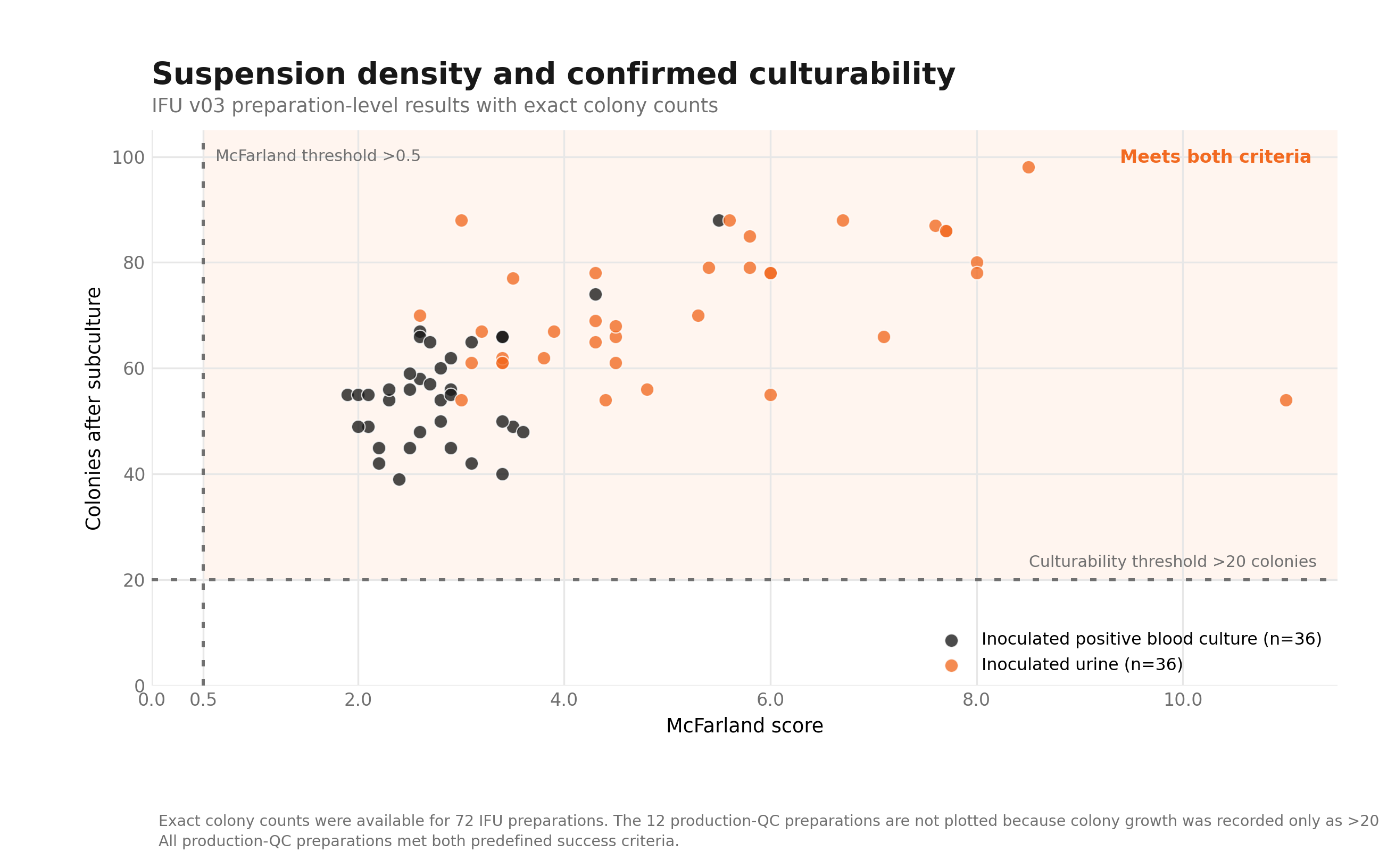
Chart comparing McFarland suspension density with colony growth for QUICKprep preparations
McFarland distribution across evaluated preparationsEach point represents the measured suspension density of one preparation. Colony growth confirms culturability.Supporting figure: McFarland measures suspension turbidity; it does not, by itself, demonstrate microorganism viability.
Calculation methodPreparation success rate = preparations meeting both criteria / all evaluable preparation attempts x 100.
Primary performance dataset View underlying data

Legend: McF = McFarland. Successful preparation = McFarland >0.5 and growth of >20 colonies after subculture.

Preparation-level results used to calculate the current QUICKprep primary performance endpoint
SourceSample matrixEvaluated preparationsMcF >0.5Mean McFMcF range>20 coloniesOverall success
IFU v03Inoculated blood culture3636/36 (100%)2.821.90-5.5036/36 (100%)36/36 (100%)
IFU v03Inoculated urine3636/36 (100%)5.282.60-11.0036/36 (100%)36/36 (100%)
Production QCInoculated urine1212/12 (100%)2.131.80-2.5012/12 (100%)12/12 (100%)
Current combined datasetAll included matrices8484/84 (100%)3.781.80-11.0084/84 (100%)84/84 (100%)

Result: 84 of 84 evaluated preparations achieved sufficient suspension density and confirmed culturability.

Interpretation: The combined mean McFarland pools different sample matrices and is provided descriptively. It is not the primary performance endpoint. Preparation success is determined by whether each preparation meets both predefined criteria.

* Based on 72 IFU evaluations using 36 strains representing 18 species in inoculated blood-culture and urine models, together with 12 production QC evaluations using urine inoculated with E. coli ATCC 25922 across four QUICKprep lots. A successful preparation was predefined as a recovered suspension measuring >0.5 McFarland and producing >20 colonies after subculture. FASTINOV data on file.

Supporting downstream evidence - not included in the primary endpoint

Performance demonstrated across downstream workflows.

Published studies show that microbial preparations obtained using QUICKprep or the FASTINOV preparation protocol can support compatible downstream identification and AST workflows. These outcomes are supporting evidence and are not included in the 84/84 primary preparation-success calculation.

Downstream ID evidence95.6%

MALDI-TOF identification agreement

Positive blood cultures - 364 clinical samples

Downstream ID evidence91.6%

Clinical urine samples identified

142 of 155 clinical positive urine samples

Downstream AST evidence>95%

AST sensitivity and specificity

Multisite validation - 670 positive blood cultures

Downstream AST evidence97.5% / 95.0%

AST agreement in inoculated urine

Gram-negative / Gram-positive bacteria - 154 samples

Evidence boundary: downstream identification and AST results support workflow compatibility. They are not direct estimates of preparation success.

Publications and studies

Evidence users can review for themselves.

Blood culture 202495.6%

Rapid identification from positive blood cultures

364 clinical positive blood cultures prepared using the FASTINOV protocol and analysed by MALDI-TOF MS. Overall identification agreement was 95.6%, with no misidentifications reported.

Cruz S, Abreu D, Gomes R, et al. Eur J Clin Microbiol Infect Dis. 2024;43:605 610.

Read the PubMed record
Urine 202691.6%

Rapid identification directly from urine

In clinical positive urine samples, 142 of 155 were identified by direct MALDI-TOF MS after QUICKprep preparation. The reported direct-identification workflow took approximately 15 minutes.

Sousa-Pinheiro M, Martins-Oliveira I, Abreu D, et al. Eur J Clin Microbiol Infect Dis. Published online 2026.

Read the PubMed record
AST 2026<2 h

Direct AST from inoculated urine samples

A proof-of-concept study evaluated 154 inoculated urine samples using FASTgramneg and FASTgrampos flow-cytometry panels, with results interpreted according to EUCAST criteria.

Sousa-Pinheiro M, Martins-Oliveira I, Abreu D, et al. Microorganisms. 2026;14(3):711.

Read the full article
AST 2024>95%

Multisite AST validation from positive blood cultures

A three-site validation of 670 positive blood cultures reported sensitivity and specificity above 95% for every antimicrobial evaluated.

Pina-Vaz C, Silva-Dias A, Martins-Oliveira I, et al. BMC Microbiol. 2024;24:187.

Read the PubMed record

Data on file

Data included in the current calculation.

The current preparation-success calculation combines 72 preparation evaluations reported in QUICKprep IFU v03 and 12 production quality-control evaluations performed in 2026.

Published downstream identification and AST outcomes are not included in the primary preparation-success calculation. Additional direct preparation studies may be added when preparation-level McFarland and culturability results are available.

IFU v03 - inoculated blood culture36/36 100%
IFU v03 - inoculated urine36/36 100%
Production QC 2026 - inoculated urine12/12 100%
Current combined dataset84/84 100%

* Based on 72 IFU evaluations using 36 strains representing 18 species in inoculated blood-culture and urine models, together with 12 production QC evaluations using urine inoculated with E. coli ATCC 25922 across four QUICKprep lots. A successful preparation was predefined as a recovered suspension measuring >0.5 McFarland and producing >20 colonies after subculture. FASTINOV data on file.

Validation items to be supplied
  1. CSF and HUG publications or abstracts.
  2. Patent-family identifiers and current status.

References

Scientific literature and product documentation.

  1. Cruz S, Abreu D, Gomes R, Martins-Oliveira I, Silva-Dias A, Perez-Viso B, et al. An improved protocol for bacteria identification by MALDI-TOF MS directly from positive blood cultures. Eur J Clin Microbiol Infect Dis. 2024;43:605 610. doi:10.1007/s10096-023-04725-3. PMID: 38112967.
  2. Sousa-Pinheiro M, Martins-Oliveira I, Abreu D, Gomes R, Silva-Dias A, Passos-Carneiro F, et al. Rapid identification directly from urine using QUICKprep kit. Eur J Clin Microbiol Infect Dis. Published online June 19, 2026. doi:10.1007/s10096-026-05535-z. PMID: 42319708.
  3. Pina-Vaz C, Silva-Dias A, Martins-Oliveira I, Gomes R, Perez-Viso B, Cruz S, et al. A multisite validation of a two hours antibiotic susceptibility flow cytometry assay directly from positive blood cultures. BMC Microbiol. 2024;24(1):187. doi:10.1186/s12866-024-03341-1. PMID: 38802760.
  4. Sousa-Pinheiro M, Martins-Oliveira I, Abreu D, Gomes R, Silva-Dias A, Poeta P, et al. A proof-of-concept of a 2-hours direct antimicrobial susceptibility test from inoculated urine samples. Microorganisms. 2026;14(3):711. doi:10.3390/microorganisms14030711.
  5. FASTINOV S.A. QUICKprep Kit: Instructions for Use. Document TF-PREP-IFU. Version 03. Porto: FASTINOV S.A.; 4 March 2026.

Species-level performance

Performance demonstrated across 18 species.

The current dataset includes 36 strains representing 18 species. Each IFU strain was evaluated in inoculated blood-culture and urine models. All evaluated preparations met both predefined preparation-success criteria.

18species represented
36strains evaluated
84preparations
100%meeting both criteria
View species-level results Expand table
Species-level preparation performance. Successful preparation = McFarland >0.5 and more than 20 colonies after subculture.
Species reported in sourceSourceMatricesPreparationsMcF >0.5Mean McFMcF range>20 coloniesOverall success
Acinetobacter baumanniiIFU v03BC, urine44/43.522.80–4.304/44/4 (100%)
Candida albicansIFU v03BC, urine44/45.922.20–11.004/44/4 (100%)
Candida glabrataIFU v03BC, urine44/43.422.70–4.304/44/4 (100%)
Candida kruseiIFU v03BC, urine44/42.522.00–3.404/44/4 (100%)
Candida parapsilosisIFU v03BC, urine44/44.722.70–7.104/44/4 (100%)
Candida tropicalisIFU v03BC, urine44/44.222.60–6.704/44/4 (100%)
Enterobacter aerogenesIFU v03BC, urine44/43.621.90–5.404/44/4 (100%)
Enterococcus faecalisIFU v03BC, urine44/45.803.40–8.504/44/4 (100%)
Enterococcus faeciumIFU v03BC, urine44/43.752.30–5.604/44/4 (100%)
Escherichia coli1IFU v03 and production QCBC, urine1616/162.791.80–7.7016/1616/16 (100%)
Klebsiella pneumoniaeIFU v03BC, urine44/45.303.50–7.604/44/4 (100%)
Morganella morganiiIFU v03BC, urine44/42.622.00–3.404/44/4 (100%)
Proteus mirabilisIFU v03BC, urine44/42.832.30–3.204/44/4 (100%)
Pseudomonas aeruginosaIFU v03BC, urine44/43.182.20–4.404/44/4 (100%)
Serratia marcescensIFU v03BC, urine44/43.122.40–4.504/44/4 (100%)
Staphylococcus aureusIFU v03BC, urine44/45.002.90–7.704/44/4 (100%)
Staphylococcus epidermidisIFU v03BC, urine44/45.032.50–8.004/44/4 (100%)
Staphylococcus hominisIFU v03BC, urine44/43.552.90–4.504/44/4 (100%)
CombinedIFU and production QCBC, urine8484/843.781.80–11.0084/8484/84 (100%)

All 18 represented species achieved 100% preparation success in the evaluated inoculated models. Mean McFarland values are descriptive measures of suspension density; confirmed culturability was established separately by growth of more than 20 colonies after subculture.

1 The E. coli row combines four IFU preparations with 12 production-QC preparations. The QC evaluations used E. coli ATCC 25922 in inoculated urine across four QUICKprep lots.

Nomenclature note: Species names are reproduced as reported in IFU v03. Some organisms, particularly Enterobacter aerogenes and Candida krusei, have updated accepted names; the public page should retain the controlled IFU terminology or add the accepted name with the IFU-reported synonym in parentheses.

Abbreviations: BC, inoculated blood culture; McF, McFarland.

Supporting evidence

Sample preparation enabling rapid phenotypic AST.

FASTINOV’s development of ultra-rapid antimicrobial susceptibility testing by flow cytometry required an effective sample-preparation step. Blood cells, proteins, debris and other sample components can create background signals and artefacts that interfere with cytometric analysis.

The FASTINOV workflow incorporates a preparation protocol designed to reduce interference, recover microorganisms at an adequate concentration and maintain the functional cellular condition required for phenotypic AST. The recovered suspension is adjusted to 0.5 McFarland before panel inoculation.

How to interpret this evidence: These studies demonstrate successful downstream use of FASTINOV-prepared microorganisms. They support the scientific basis and functional performance of the preparation approach, but are not direct estimates of the current QUICKprep primary endpoint, which requires McFarland >0.5 and more than 20 colonies after subculture.

POSITIVE BLOOD CULTURES · INTERNAL AND CLINICAL EVALUATION · 2021

447 positive blood cultures evaluated with viability- and concentration-controlled AST

A foundational validation evaluated FASTINOV phenotypic AST using 447 positive blood cultures: 347 inoculated and 100 clinical positive blood cultures.

Why this study supports the preparation

Following sample preparation, the recovered bacterial concentration was adjusted to 0.5 McFarland and used to inoculate FASTgramneg or FASTgrampos flow-cytometry panels. Integrated controls assessed bacterial viability and metabolic condition, microorganism concentration, control-well cell numbers and fluorescent-probe performance. Invalid assays were rejected and repeated.

447Positive blood cultures
347 / 100Inoculated / clinical
0.5 McFPrepared inoculum
96.8% / 98.6%Gram-negative / Gram-positive categorical agreement
<2 hAST time to result

Conclusion: FASTINOV-prepared bacterial suspensions met the concentration and functional-control requirements needed for rapid phenotypic AST. The study did not report a separate first-pass preparation-success rate.

Evidence type: Supporting functional evidence
Primary endpoint contribution: Not included

Silva-Dias A, Pérez-Viso B, Martins-Oliveira I, Gomes R, Rodrigues AG, Cantón R, et al. J Clin Microbiol. 2021;59(10):e00544-21.

Read the full article →

POSITIVE BLOOD CULTURES · THREE-SITE VALIDATION · 2024

670 positive blood cultures supported accurate AST in under two hours

A subsequent multisite study validated the FASTINOV AST workflow across three laboratories using 670 positive blood cultures: 333 inoculated and 337 clinical positive blood cultures.

Why this study supports the preparation

The workflow prepared microorganisms directly from the positive blood-culture bottle, reduced remaining blood components, recovered a bacterial pellet and produced a suspension adjustable to 0.5 McFarland. The method required sufficient concentration, reduced matrix interference, an analysable untreated control population and bacteria capable of measurable phenotypic responses.

670Positive blood cultures
333 / 337Inoculated / clinical
3Study sites
>95%Sensitivity and specificity
>97%Overall categorical agreement
<2 hAST time to result

Conclusion: The multisite results show that the FASTINOV preparation approach supported accurate phenotypic susceptibility analysis across laboratories and sample types in under two hours. The study did not define preparation success using the current QUICKprep criteria or report a separate first-attempt preparation-failure rate.

Evidence type: Supporting functional evidence
Primary endpoint contribution: Not included

Pina-Vaz C, Silva-Dias A, Martins-Oliveira I, Gomes R, Perez-Viso B, Cruz S, et al. BMC Microbiol. 2024;24(1):187.

Read the full article →
From preparation to functional result

Across two large studies involving hundreds of inoculated and clinical positive blood cultures, FASTINOV-prepared microorganisms supported accurate phenotypic AST in under two hours. The studies describe FASTINOV sample-preparation protocols that provided the scientific and technical foundation for QUICKprep.

Part 01 · Scientific foundation

Remove the interference.
Preserve the biological response.

Flow cytometry can detect early cellular changes following antibiotic exposure—but only when microorganisms can be analysed against a sufficiently clean background.

Positive blood culture containing microorganisms, human cells, proteins, debris and other sample components
01 · The challenge

Complex samples obscure the signal.

Blood cells, proteins, debris and other sample components can create noise and artefacts that interfere with flow-cytometry analysis.

02 · The response

Separate the microorganisms from the matrix.

FASTINOV developed a proprietary preparation approach to reduce matrix interference while recovering a concentrated suspension of viable, physiologically responsive bacteria or yeasts.

03 · The result

Enable rapid phenotypic AST.

The prepared suspension provides the concentration and functional cellular condition needed to support accurate AST results in less than two hours.

Part 01 · Why QUICKprep was developed

Before microorganisms can be tested, they must be separated from the sample.

Positive blood cultures, urine and other critical samples contain microorganisms together with human cells, proteins, cellular debris and other matrix components.

Traditional microbiology resolves this complexity by growing isolated colonies before identification and antimicrobial susceptibility testing. However, these additional culture steps delay results.

Direct-from-sample testing can reduce this delay—but first, the laboratory must recover the microorganisms at a sufficient concentration while preserving their viability and capacity to respond to antibiotics.

Positive blood culture containing microorganisms, human cells, proteins, debris and other sample components

The challenge FASTINOV needed to solve

Reduce interference while preserving the biological response.

While developing rapid phenotypic AST by flow cytometry, FASTINOV needed a reliable and fast way to prepare microorganisms directly from positive samples.

Flow cytometry detects early cellular changes following antibiotic exposure. Blood cells, proteins, cellular debris and other sample components can create background noise and artefacts that interfere with this analysis.

The preparation therefore had to meet two requirements:

01 · Reduce matrix interference

Separate microorganisms from components that could obscure or distort the flow-cytometry signal.

02 · Preserve functional microorganisms

Recover viable microorganisms capable of responding to antibiotic exposure during phenotypic AST.

FASTINOV’s response

A dedicated method for preparing microorganisms directly from positive samples.

FASTINOV developed a proprietary sample-preparation approach designed to reduce matrix interference while recovering a concentrated pellet of viable bacteria or yeasts.

This preparation approach became the scientific and technical foundation of QUICKprep.

The result

A microorganism pellet ready for standardization.

Using QUICKprep, the technician separates microorganisms from the original sample matrix and recovers a pellet that can be resuspended and adjusted to the concentration required by the intended downstream method.

In FASTINOV’s flow-cytometry AST studies, suspensions prepared using this approach supported phenotypic antimicrobial susceptibility results in less than two hours.

How QUICKprep works

From a complex sample to a standardized microorganism suspension.

01

Treat the original sample

The technician adds the QUICKprep reagents according to the Instructions for Use.

02

Separate the microorganisms

The prescribed reagent treatments reduce interference from human cells, proteins, cellular debris and other components of the original sample.

03

Recover the microorganism pellet

After processing, the technician recovers a concentrated pellet containing bacteria or yeasts.

04

Prepare the required suspension

The recovered microorganisms can be resuspended and adjusted to a standardized 0.5 McFarland suspension, according to the requirements of the intended downstream method.

Procedure summary only. Refer to the current QUICKprep Instructions for Use for complete specimen requirements, volumes, processing conditions, warnings and operating instructions.

FASTINOV research and proprietary technology

Built on FASTINOV’s research in rapid microbiology.

QUICKprep grew out of FASTINOV’s research into rapid phenotypic antimicrobial susceptibility testing by flow cytometry.

That research established the need for a sufficiently concentrated microorganism suspension with reduced matrix interference, while retaining the viability and functional cellular response required for phenotypic testing.

Patents and proprietary researchThe technology underlying QUICKprep is supported by FASTINOV’s proprietary research and international patent portfolio.